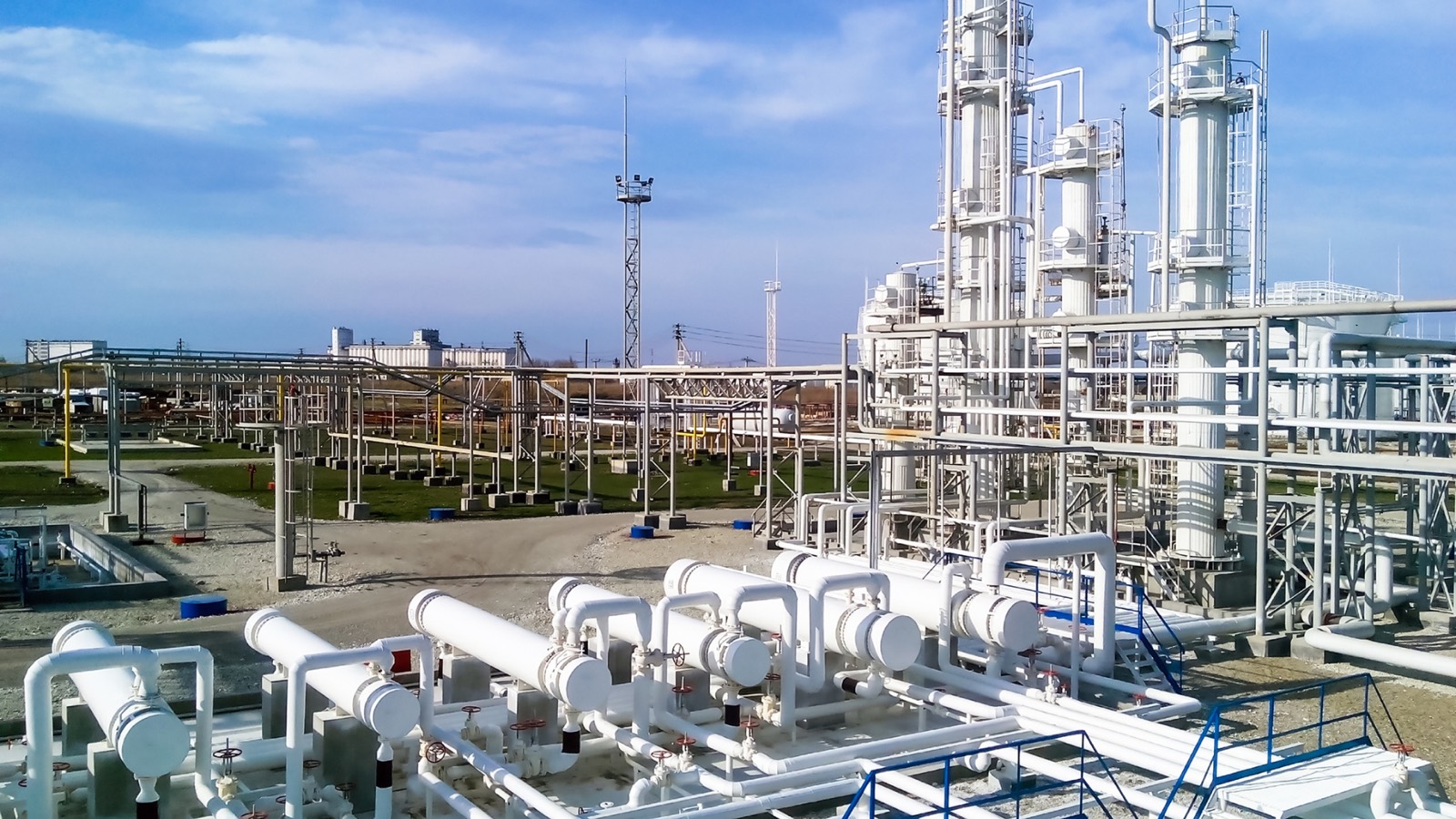

Take an LNG plant with two 5 Mtpa trains and four 180,000 m3 tanks, and stop the ships. If the tanks were half full when the last carrier left, they reach their working maximum in 5.4 days at nameplate. If the loading schedule had let them sit at 80%, they reach it in 1.8. Everything the plant can do after that, turning the trains down, shutting one in, shutting both, works on the room that is left, so the 30 extra points of fill already in the tanks cut the value of every one of those decisions to a third.
The plant is invented, and so are its numbers. The situation it is built for is not. LNG transits of the Strait of Hormuz have been severely disrupted since early March 2026. QatarEnergy ceased LNG production on 2 March after military attacks on its facilities at Ras Laffan and Mesaieed [1], and had declared force majeure to affected buyers by 4 March [2]. Iranian strikes on Ras Laffan later in the month damaged two of its 14 trains, 12.8 Mtpa or about 17% of Qatar's export capacity, and the company's chief executive, Saad al-Kaabi, put the repair at three to five years [3]; on 21 September he said three [4]. ADNOC Gas, whose 6 Mtpa Das Island plant sits inside the Gulf, said on 23 March that it had made temporary adjustments to LNG production because of the shipping disruption while its operations continued safely [5]. After the Qatari carrier Al Rekayyat came under fire in the strait on 7 July, Qatar scaled Ras Laffan back to a minimum and loaded fewer vessels [6]. In August Kpler saw no visible transits by Qatar-linked LNG carriers at all, and in September they began to pick up again [7].
ADNOC's position is the one this piece is about: a plant that can run, with gas arriving at the inlet and fewer ships than it has LNG. A plant that is still running has gas and nowhere to send it, and its tanks are the only buffer between the last cargo and a shut-in.
Liquefaction fills the tanks and loading empties them
Storage is a mass balance with three terms. Liquefaction fills the tanks at the train rate, boil-off takes a little out, and loading takes it out in large steps. When loading stops, the inventory rises at the net rate, and the days until the tanks are full are the working room divided by that rate:
Here f is the fill as a fraction of storage, m_tank the mass of LNG in the tanks when full, and q the production and boil-off rates in tonnes a day. Each response changes one term. Turndown lowers q_prod on every running train, as far as the minimum stable rate. A train shut-in removes that train's share. Shutting wells in upstream lowers the gas the plant receives, which in the end is one of the other two. The starting fill is the only term that is fixed before the ships stop, and it sits in the numerator, where it scales every answer.
The invented plant
The plant has two trains of 5 Mtpa, four full-containment tanks of 180,000 m3 and LNG at 0.45 t/m3, so 324,000 t of LNG when the tanks are full. Boil-off is 0.05% of full storage a day, 162 t/d. The working maximum is 95%, the unpumpable heel is 10%, and each train's minimum stable rate is taken as 60% of nameplate. Every one of these values is illustrative, and each sits inside a public range. VINCI's 2021 contract with National Grid at the Isle of Grain was for a single 190,000 m3 full-containment tank [8]. Ras Laffan's common storage is twelve tanks of 140,000 and 85,000 m3 [9]. A simulation of a full-containment tank puts the boil-off rate at 0.012% of contents a day at 80% fill and 0.12% at 10% fill [10]. One licensor's own product card claims turndown from 100% to 10% of nameplate, which makes 60% a cautious placeholder [11]. A real plant's values are its own, and they are not public.
| Case, no loading | Production, t/d | Days until 95% full |
|---|---|---|
| Tanks half full, both trains at nameplate | 27,397 | 5.4 |
| Half full, both trains at the 60% minimum | 16,438 | 9.0 |
| Half full, one train shut in, the other at nameplate | 13,699 | 10.8 |
| Half full, one train shut in, the other at 60% | 8,219 | 18.1 |
| Half full, both trains shut in | 0 | never |
| Tanks 80% full, both trains at nameplate | 27,397 | 1.8 |
Turning both trains down to 60% adds about two-thirds to the cover, from 5.4 days to 9.0, and shutting one train in on top of that doubles it, to 18.1. They are different kinds of decision. The shift that took the turndown can reverse it. A train that has been shut in has to be restarted, which costs time, flaring and, if its cold box has warmed, a cooldown; even the licensor that sells fast restarts sells them on cold boxes that stay cold through an outage [11].
Boil-off buys almost nothing. At 162 t/d it is 0.6% of nameplate production, and in practice it does not make room in the tanks either, because the gas is compressed to fuel or reliquefied: at Ras Laffan the common storage recovers it and sends it to the trains as fuel gas [9]. The model lets it leave the tank. With both trains shut in, the level then falls by 0.05 points of storage a day, which is time the plant buys only by stopping, and the boil-off has to go to a reliquefier, whatever fuel users are still running, or the flare.
The starting inventory is what matters most. From 80% full there are 15 points of working room, against 45 from half full, and because every response divides the same room, every response is worth a third as much. Taken the moment the ships stop, the four responses in the table give 5.4, 9.0, 10.8 and 18.1 days from half full and 1.8, 3.0, 3.6 and 6.0 days from 80%. The cheapest insurance against a blocked export is tank room, and it is a loading-schedule decision taken weeks before anyone in the control room is asked to choose.
The fill also sets the deadline
A table of days of cover treats each response as if it were taken at the instant the last ship leaves. A plant takes them in sequence, on particular days, and the exhibit lays the sequence out on a time axis.
Decision deadline. Even done at once, shutting 1 train does not meet ships on day 6.0. Add the turndown, or shut more trains.
From 80% full, every response is worth 33% of what it is worth from half full, because every one of them divides the same working room. Boil-off is held at 0.05% of full storage a day and leaves the tank; the model stops at the first loading.
It opens on the 80% case at nameplate, with the ships promised back on day 6, a date chosen for illustration. The line reaches the working maximum on day 1.8, and the plant then has to hold production down to what boil-off removes for the remaining 4.2 days. Drag the starting fill down to 50% and the same line runs to day 5.4, still 0.6 days short of the ships. The steel dashed line keeps the other case on screen, and the ladder on the right shows all four responses shrinking together as the fill rises.
The time axis shows what the table cannot: the latest moment each move can be made. From half full, with both trains turned down at once and the ships due back on day 12, the second train can run until day 6.0 before it must be shut in. From 80% full, with the ships due on day 6, the plant has to turn down and shut a train within 45 minutes of the last ship leaving, and it meets the ships with under 0.1% of its storage to spare. That deadline is fragile in a way the table hides: at a boil-off of 0.03% of storage a day instead of 0.05%, no order of turndown and shut-in meets day-6 ships from 80%. From half full the plant decides in days. From 80% it decides in minutes, or it has already lost.
Ras Laffan's published storage
Ras Laffan's common storage and loading facility has twelve tanks, eight of 140,000 m3 and four of 85,000 m3, 1.46 million m3 in all, and it serves Qatargas' seven trains and RasGas Trains 6 and 7 [9]. Six of Qatar's 14 trains are mega trains of 7.8 Mtpa [12], and all six are among those nine. At the invented plant's 0.45 t/m3 the storage holds about 657,000 t, and the six mega trains alone make about 128,000 t/d. From half full the tanks would be full in 2.3 days, from 80% in under 19 hours, and from the heel in 4.4 days. Those are upper bounds, because Qatargas' three original trains also feed the storage and are left out, and they are a counterfactual, because Qatar did not try to fill its tanks: it stopped production on 2 March [1]. Two days of room is no buffer against a disruption that has now run for seven months. The exhibit's second plant setting puts these figures on the same axes.
What a shut-in does to the wells
When the plant takes less gas, the wells feeding it are choked back or shut in, and for gas-condensate wells that is where the restart gets difficult. Below the dew point, condensate drops out around the wellbore and forms a bank that cuts the well's gas productivity. A shut-in lets near-well pressure build back up, and a common practice has been to shut wells in after condensate has dropped out in the hope that it revaporizes. Laboratory flow experiments by Vo and Horne at Stanford found that hope misplaced. As condensate accumulates, the fluid near the wellbore becomes richer in heavy components and its phase envelope shifts, so on shut-in the condensate does not go back into the gas the way the original phase diagram says it should [13]. A well that comes back after weeks shut in can bring its bank back with it, at a condensate yield and composition different from the stream the plant was taking before. That makes the restart a scenario on the feed side as much as on the plant side, and the mass balance above contains none of it.
The order of the steps
Any of the days of cover here can be done on a napkin. What is hard to reconstruct afterwards is why the plant turned down before it shut a train in, why it shut train 2 rather than train 1, and what the inventory and the ship schedule were when it chose. Each step is a change of one input to the same balance, so each can be kept as a run with its inputs, its result and the time it was taken, and when the ships return the restart order becomes more runs on the same record.
Key takeaways
- Days of cover are the working room divided by the net fill rate: on the invented two-train plant, 5.4 days from half full at nameplate and 1.8 days from 80%.
- Turndown to 60% gives 9.0 days from half full and one train shut in with the other turned down gives 18.1; from 80% the same four responses give 1.8, 3.0, 3.6 and 6.0 days, a third of their half-full value.
- The starting fill also sets the deadline: from half full, with the ships back on day 12, the second train can wait until day 6.0; from 80%, with the ships back on day 6, it has to be shut within 45 minutes, and at a lower boil-off it cannot be done at all.
- Ras Laffan's published 1.46 million m3 of common storage, against only its six 7.8 Mtpa mega trains, would be full in at most 2.3 days from half full and under 19 hours from 80%.
- Shutting a gas-condensate well in does not reliably revaporize the condensate bank, so a restart can bring back a different stream from the one the plant gave up.
Limitations
The plant is invented. Its tank size, density, working maximum, heel, minimum stable rate and boil-off are illustrative, and a real plant's limits, including how fast each train can actually be turned down, will move every number here. Turndown and shut-in are modelled as instantaneous; a real ramp takes hours, and over a 45-minute deadline that matters.
Boil-off is held at a constant 0.05% of full storage a day, although the cited simulation puts it between 0.012% and 0.12% of contents depending on fill, and recovered boil-off goes to fuel or a reliquefier rather than simply leaving. The 45-minute deadline is sensitive to it, as the text says.
There is no jetty in the model and no ship schedule beyond a single day of return. The real disruption was partial, with some carriers thought to have transited with their transponders off and others waiting, and the model stops at the first loading instead of drawing the draw-down.
The Ras Laffan case counts only the six mega trains, uses the invented plant's density, maximum and heel, and assumes the nine trains' LNG goes only to the common storage described in 2015. It is an upper bound on a situation that did not happen, because production stopped.
The upstream side is described here and left out of the model, which has no wells, no condensate bank and no restart cost, so it cannot say how long a shut-in field takes to come back or what it will deliver when it does.
References
- MEED. Qatar halts LNG production after attack on facilities. 2 March 2026: meed.com.
- Gulf News. QatarEnergy declares force majeure after LNG production halt. Updated 4 March 2026: gulfnews.com.
- Al Jazeera. QatarEnergy declares force majeure on some LNG contracts. 24 March 2026, for two of 14 trains damaged, 12.8 Mtpa, about 17% of export capacity and a three-to-five-year repair: aljazeera.com.
- Qatar Living. Repairing the two Ras Laffan LNG lines will take three years, remarks by Saad al-Kaabi at the Qatar Economic Forum in New York, 21 September 2026: qatarliving.com; and Oil & Gas Journal, QatarEnergy NFE LNG Train 1 to start 1H 2027; Ras Laffan repairs to take 3 years, 22 September 2026: ogj.com.
- Baird Maritime, from Reuters. ADNOC Gas adjusts LNG output amid Strait of Hormuz disruptions. 23 March 2026: bairdmaritime.com.
- TASS, citing Bloomberg. Report from New York, 9 July 2026, on Qatar scaling Ras Laffan back to a minimum after the attack on Al Rekayyat: tass.com.
- Baird Maritime, from Reuters. Defying conflict, Qatar-linked LNG tankers return to the Strait of Hormuz. 28 September 2026, citing Kpler: bairdmaritime.com.
- VINCI. VINCI wins the construction contract of a liquefied natural gas tank in the UK. 28 January 2021: vinci.com.
- Offshore Energy. Qatargas hits 5,000th LNG cargo milestone. 6 April 2015, for the twelve tanks, the trains they serve and boil-off recovery to fuel gas: offshore-energy.biz.
- M. S. Khan, M. A. Qyyum, W. Ali, A. Wazwaz, K. B. Ansari and M. Lee. Energy saving through efficient BOG prediction and impact of static boil-off rate in full containment-type LNG storage tank. Energies 13(21): 5578, 2020: doi.org/10.3390/en13215578.
- ConocoPhillips LNG Licensing. Optimized Cascade process quick reference card, a vendor claim: conocophillips.com.
- QatarEnergy LNG. About us, for 14 trains, six of them mega trains of 7.8 Mtpa, and 77 Mtpa in total: qatarenergylng.qa.
- H. X. Vo and R. N. Horne. Experimental study of composition variation during flow of gas-condensate. SPE Annual Technical Conference and Exhibition, Houston, 2015, SPE-175011-MS: doi.org/10.2118/175011-MS.
- EarthScan tank-cover bench, synthetic throughout, the source of every invented-plant figure above; available on request.