“Train on F3, deploy on Penobscot - without ever showing the model a Penobscot label. That's the question this paper asks, and the architecture that answers it.
”
I. Introduction
Interpretation of geologic features and inference of reservoir properties are foundational to hydrocarbon exploration and production. Seismic images are acquired in different stratigraphic settings and are related to one another by reflection patterns and depositional environments - but the same lithology can look subtly different across two surveys, two basins, or two acquisition vintages.
This article presents an approach for accurate and robust semantic segmentation of seismic images using cropped local image patches, applied to two well-known public datasets: the F3 block (Netherlands)A canonical public seismic dataset from the Dutch sector of the North Sea. 401 crosslines × 701 inlines at 401×701 pixel resolution, with per-slice facies labels (Alaudah et al., 2019). The default benchmark for academic seismic-AI work. and Penobscot (Canada)A Canadian public seismic dataset (Scotian Shelf, Atlantic offshore Canada). Different acquisition vintage and structural setting from F3 - making it a clean target domain for cross-basin domain-adaptation experiments.. It's the applied companion to our EarthAdaptNet architecture paper and the precursor to our 2022 IEEE TGRS publication.
F3 + Penobscot - headline numbers
Facies classes labelled on F3 (source domain)
Accuracy on smaller, under-represented classes (Zechstein, Scruff)
RB - TRB pairs in the best-performing ASPP variant
First applications of deep domain adaptation to unlabelled seismic facies
Dataset
We use two processed-seismic datasets:
- F3 block (Netherlands) - the canonical public seismic dataset for academic seismic-AI work. 401 crosslines × 701 inlines at 401 × 701 pixel dimension. Slices were previously interpreted and annotated by Alaudah et al. (2019), giving us a per-slice label mask covering 6 facies classes.
- Penobscot (Canada) - a complementary public dataset with different acquisition vintage and structural setting. Used as the target domain in our domain-adaptation experiments.
Generating these seismic images is itself a sophisticated process: intense sound sources placed 6-76 m below ground generate the source wavelet; reflected returns are recorded by surface or seabed sensors; the raw recordings are processed through an iterative inversion to produce the volumetric image. The same iterative pipeline applies to crossline slices (depth-axis images perpendicular to the crossline direction).
Proposed network architectures
We use EarthAdaptNet (EAN) and three architectural variants. The full block-by-block architecture description lives in the companion architecture post; briefly:
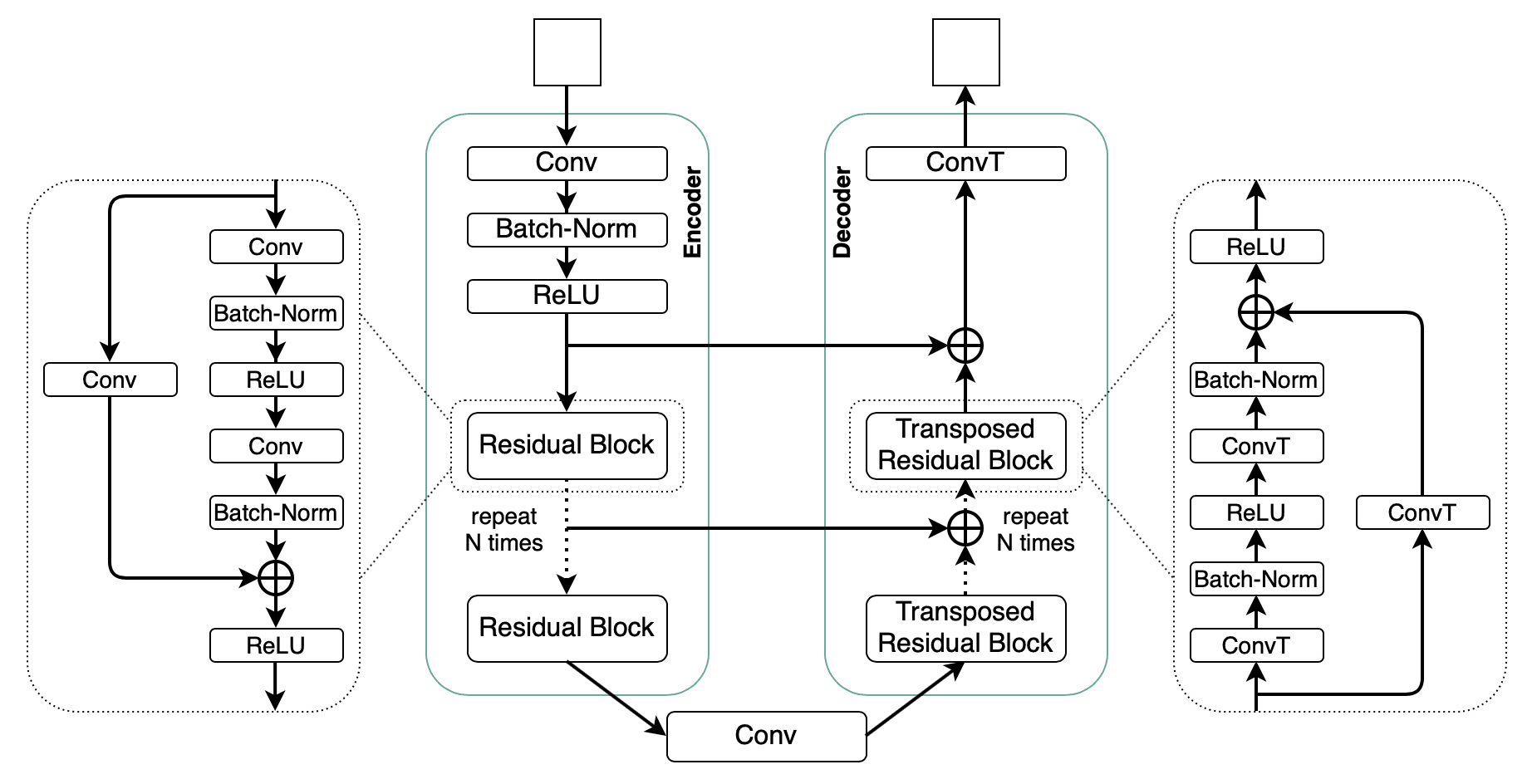
- Residual Blocks (RBs) - contracting path. Two convolutional layers + batch norm + a 1×1 downsampling residual connection. Notable detail: there's no batch-norm layer on the shortcut connection itself, which we found stabilises training.
- Transposed Residual Blocks (TRBs) - expanding path. Mirror structure with transposed convolutions for upsampling.
- Encoder - decoder assembly - the two paths joined by a 1×1 bottleneck, with skip connections at every depth (U-Net-style).
For this study, we tested several head configurations:
- Patch-segmentation head - the original full encoder - decoder for per-pixel facies classification within each 40×40 patch.
- GAP-classification head A - 4 RBs followed by Global Average Pooling and 2 fully-connected layers, for whole-patch classification.
- GAP-classification head B - 3 RBs followed by GAP and 2 FC layers, a smaller variant.
- ASPP variantAtrous Spatial Pyramid Pooling - five parallel atrous (dilated) convolutional layers at different rates, concatenated and reduced. Captures multi-scale context at the bottleneck without losing resolution. Originally proposed in DeepLab (Chen et al., 2017). - Atrous Spatial Pyramid Pooling at the bottleneck (5 parallel atrous-conv layers concatenated and reduced to 256 channels), for capturing multi-scale context.
Results on F3
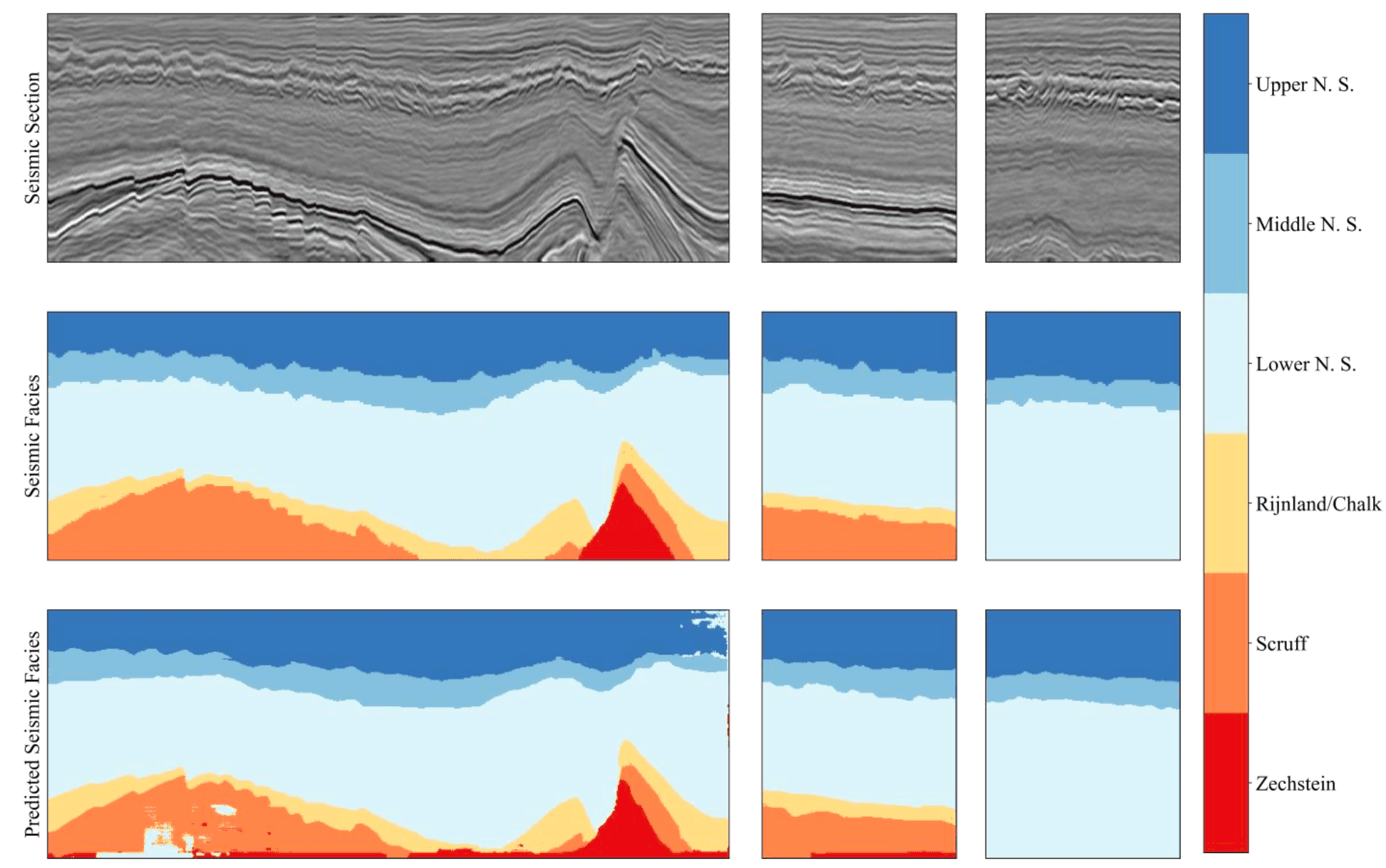
On F3 (in-domain training and testing), the ASPP variant of EAN with 4 RB - TRB pairs achieved the best test-set performance. Some misclassifications remained for inline 295 and crossline 620 - generally on the boundaries between adjacent facies in regions where two human interpreters would also disagree.
Note: The original architecture and results figures for this article were stored on the Strapi instance at
strapi-production-030c.up.railway.app, which is no longer running. The figures will be restored from the IEEE TGRS publication PDF in a follow-up content pass.
Deep domain adaptation (DDA)
The interesting question - and the one that motivated this whole research line - is what happens when you train on F3 and deploy on Penobscot? Standard answer: accuracy collapses, sometimes catastrophically, because the source and target distributions are different.
We extended EAN with a deep domain-adaptationA family of techniques for adapting a model trained on a labelled source domain to perform well on an unlabelled (or sparsely-labelled) target domain. The unsupervised variant - used in EAN-DDA - relies only on unlabelled target data, exploiting feature-distribution alignment. (DDA) approach: feature-space alignment losses at the bottleneck that pull the encoder's representation of F3 patches toward the encoder's representation of unlabelled Penobscot patches.
Three architectural variants were examined to understand which components matter most for adaptation:
- RB-only adapter
- RB + GAP adapter
- Full RB + GAP + FC adapter
Each variant trades parameter count for adaptation capacity. The full paper covers the comparison in detail.
Conclusion
Three results worth highlighting:
- EAN classifies F3 facies efficiently with patch sections, achieving classification accuracy >50% even for the smaller, harder classes like Zechstein and Scruff - both notoriously thin and under-represented.
- The architecture beats the patch-based baseline by a meaningful margin across all facies classes.
- The proposed DDA approach is one of the first applications of deep domain adaptation to unlabelled seismic facies, opening a path to deploy a model trained on one well-imaged basin to another basin where labels don't exist yet.
The full peer-reviewed treatment is published in IEEE Transactions on Geoscience and Remote Sensing:
M. Q. Nasim, T. Maiti, A. Srivastava, T. Singh, J. Mei. Seismic Facies Analysis: A Deep Domain Adaptation Approach. IEEE Transactions on Geoscience and Remote Sensing, 60, 1-16, 2022, Art. no. 4508116. DOI: 10.1109/TGRS.2022.3151883
Key takeaways
- F3 + Penobscot is the canonical cross-basin DDA testbed - same lithology family, different acquisition vintages, no shared labels.
- EAN beats baseline architectures across all 6 facies classes, with the largest gains on under-represented classes (Zechstein, Scruff > 50%).
- ASPP at the bottleneck (5 atrous convs at different rates) was the highest-performing variant - captures multi-scale context without sacrificing resolution.
- First-known application of unsupervised deep domain adaptation to seismic facies - the IEEE TGRS 2022 paper takes this further.
Glossary
- ASPP
- Atrous Spatial Pyramid Pooling - five parallel atrous (dilated) convolutional layers at different rates, concatenated and reduced. Captures multi-scale context at the bottleneck without losing resolution. Originally proposed in DeepLab (Chen et al., 2017).
- Domain adaptation
- A family of techniques for adapting a model trained on a labelled source domain to perform well on an unlabelled (or sparsely-labelled) target domain. The unsupervised variant - used in EAN-DDA - relies only on unlabelled target data, exploiting feature-distribution alignment.
- F3 block
- A canonical public seismic dataset from the Dutch sector of the North Sea. 401 crosslines × 701 inlines at 401×701 pixel resolution, with per-slice facies labels (Alaudah et al., 2019). The default benchmark for academic seismic-AI work.
- GAP
- Global Average Pooling - replaces fully-connected layers at the end of a convnet by averaging each feature map to a single scalar. Reduces parameter count dramatically and acts as a structural regulariser. Standard in modern image classifiers since Network-in-Network (Lin et al., 2014).
- Penobscot
- A Canadian public seismic dataset (Scotian Shelf, Atlantic offshore Canada). Different acquisition vintage and structural setting from F3 - making it a clean target domain for cross-basin domain-adaptation experiments.
- Stratigraphy
- The branch of geology concerned with the order and relative position of rock layers. The 'stratigraphic setting' of a seismic survey is the depositional context - alluvial fan, shallow marine, deep marine, etc. - that controls the reflection patterns the network must learn to interpret.