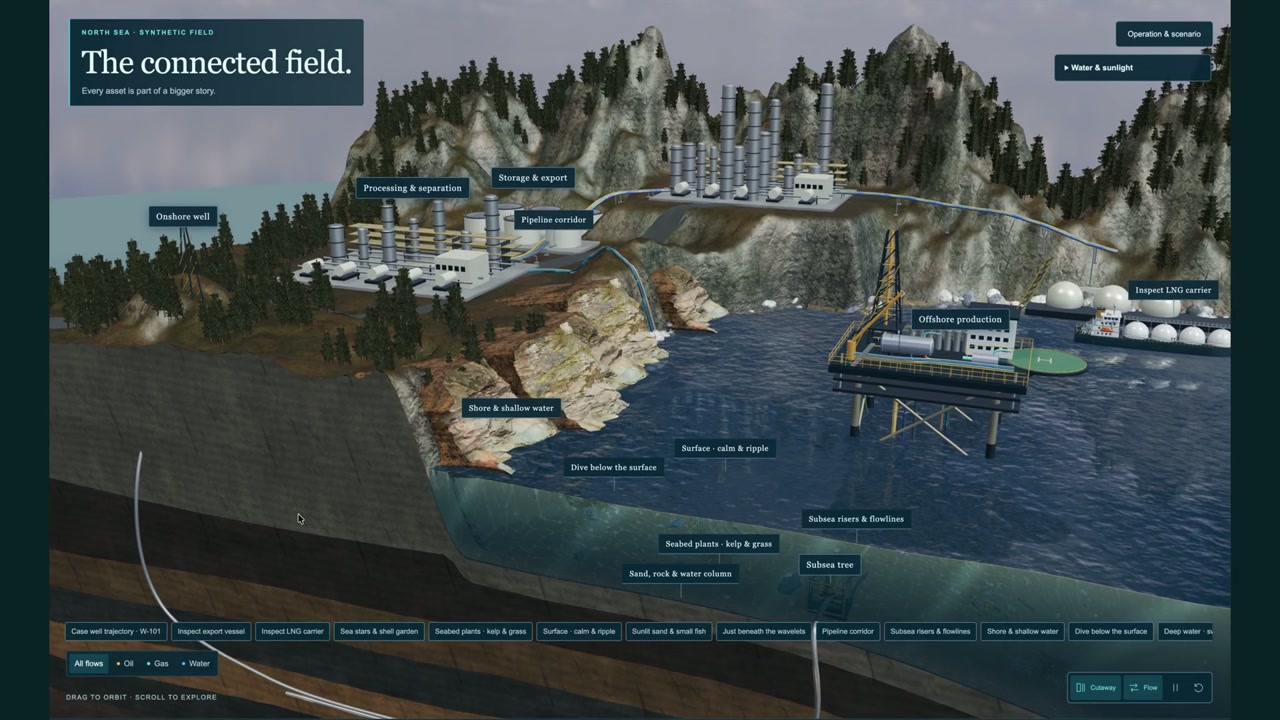
AMSTERDAM, 20 November 2026 - EarthScan first made EarthScan Twin V1 available on 25 September 2026 as a public 3D showcase with a protected engineering review workspace. Published on 20 November 2026, this announcement describes that release and the experience as it has developed since launch. Twin brings equipment, illustrative calculations and recorded evidence together in an interactive energy environment.
Built by a small team of energy, geoscience and AI specialists, Twin extends EarthScan’s work in applied AI and deep learning into a spatial experience. It gives engineers a way to inspect individual components and their context, while helping executives and multidisciplinary teams follow the relationships across an asset and the broader energy lifecycle.
From a connected world to the engineering detail
Visitors can begin with a connected energy landscape, move between assets and descend beneath the water to explore the seabed and subsea equipment. The world includes production, processing, refining, distribution, LNG export and water treatment. The interaction is designed to keep the larger system in view while making individual equipment and processes easier to understand.
In the separator experience, users can follow oil, gas and water through an equipment cutaway, inspect the inlet and mist extractor, and see how the liquid interface relates to the process. The engineering review experience pairs visual explanations with illustrative operating calculations, whose inputs, units and limits are part of the review.
The robotics experience explores an LAUV survey study and a simulated inspection mission, placing routes, sensors and assets in a shared visual context. Recorded SubPipe imagery is available separately for evidence review. These experiences demonstrate how an inspection twin could organise a task and its evidence; they do not operate a vehicle or establish a qualified defect-detection method.
The data and subsurface views bring recorded Volve material, Norwegian geography and directional-drilling illustrations into the experience. Source context, units, quality checks, accepted records and gaps help reviewers examine what a result rests on. Authored scenes, illustrative operating cases and recorded evidence are identified according to their role, so visual context can support an engineering discussion without being mistaken for a live field measurement.
Built around the way energy teams work
EarthScan’s starting point is the difficult work its team undertakes with clients: applying AI and deep learning to subsurface questions that require both technical expertise and an understanding of the available data. Twin brings that perspective to a practical communication problem: how to make a complex asset understandable across disciplines while preserving access to the detail.
The team developed Twin with Astra in Codex, combining iterative build work with inspection by its energy, geoscience and AI colleagues. The process covered the connected environment, equipment detail, interactions and calculations. The result is intended to support two complementary journeys: an executive can follow the wider system, and an engineer can move closer to the assumptions and evidence behind a particular view.
A focused path to a customer twin
EarthScan is inviting organisations to scope custom implementations around one asset and one useful task, such as reviewing an inspection, tracing an operational reading or understanding a piece of equipment. For an agreed asset and task scope, the company’s target is a first working twin in 2-3 weeks. Data access, integration complexity and the required validation determine what can be delivered within that period.
Initial customer work will focus on AI, robotics and operational data. EarthScan plans to draw on its in-house AgentOS and AI stack where appropriate, with authorised data sources, agreed access controls and human review. Data identifiers, timestamps, units and source availability would be agreed at the outset, including whether a view represents live, delayed or replayed information.
V1 today, a broader programme ahead
V1 is available for public exploration and protected engineering review. It combines authored visuals, illustrative models and recorded evidence; it is not connected to a customer’s live plant or equipment controls. Live AI inference is marked “Coming soon”. The protected workspace is a review candidate; specialist qualification and final general-availability acceptance remain open. Operational deployments require customer-specific integration and technical validation.
The original programme mapped 98 energy workflows, including 38 scoped V1 experiences and 60 additional V2 roadmap workflows. V2 is in development, with further Minerals & Mining work planned. Future releases will deepen engineering capability and customer-specific integrations, with scope and validation agreed as that work progresses.
Explore EarthScan Twin at earthscan.io/twin and request access to the protected review workspace. To discuss a custom implementation, bring the team one asset, one daily task and the data available to support it.
About EarthScan
EarthScan is an energy AI startup bringing energy, geoscience and AI expertise to complex client problems. Its work applies AI and deep learning to subsurface understanding and engineering workflows, with an emphasis on the relationship between data, technical judgement and practical use.