AMSTERDAM, 13 July 2026 - EarthScan today announced the general availability of EarthScan AI 360 on the Hominis Foundation Stack, together with a step that changes how the platform is used day to day: the pipelines inside its Agent OS are now automated end to end. Geologists can run deterministic loop engineering and harness engineering across the full value chain, upstream, midstream and downstream, on infrastructure that never leaves the operator estate.
Loop and harness engineering turn an operator’s existing assets, its corporate data, its interpretation patterns, and everything already known about its wells and gas reservoirs, into pipelines that run on their own. The result is a 360-degree, transparent, end-to-end view in which a geologist can execute fault detection, seismic imaging, well-log interpretation or any other workflow and follow every step from raw data to result.
Because the whole chain sits in one place, managers, engineers and multidisciplinary teams work from the same picture rather than from disconnected tools. The automation runs unattended and repeatably, which is what makes EarthScan AI 360 the first AI-native, hyper-automated platform built for oil and gas majors to accelerate at a pace the industry has not seen before.
The platform in practice: reviving a mature offshore basin
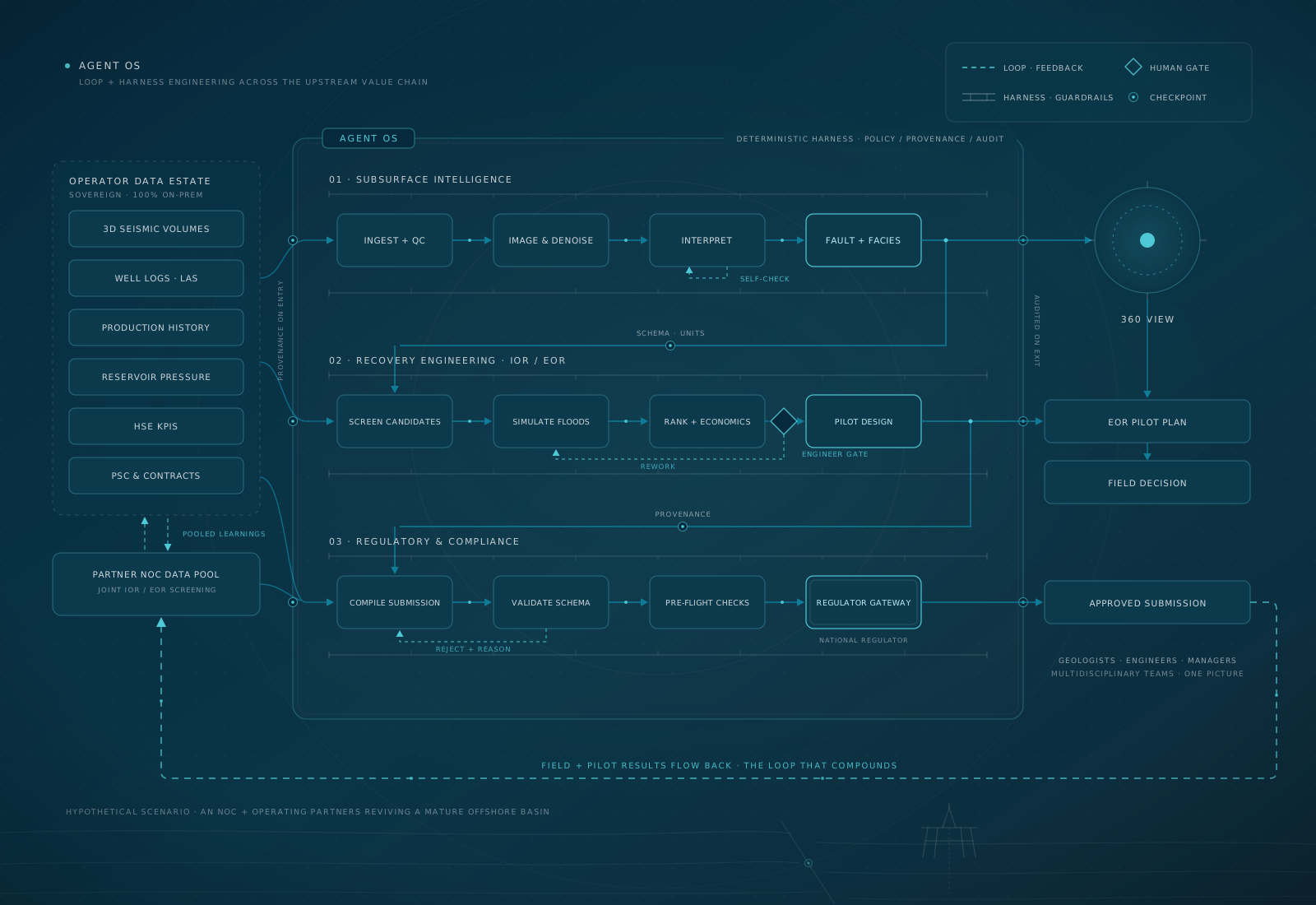
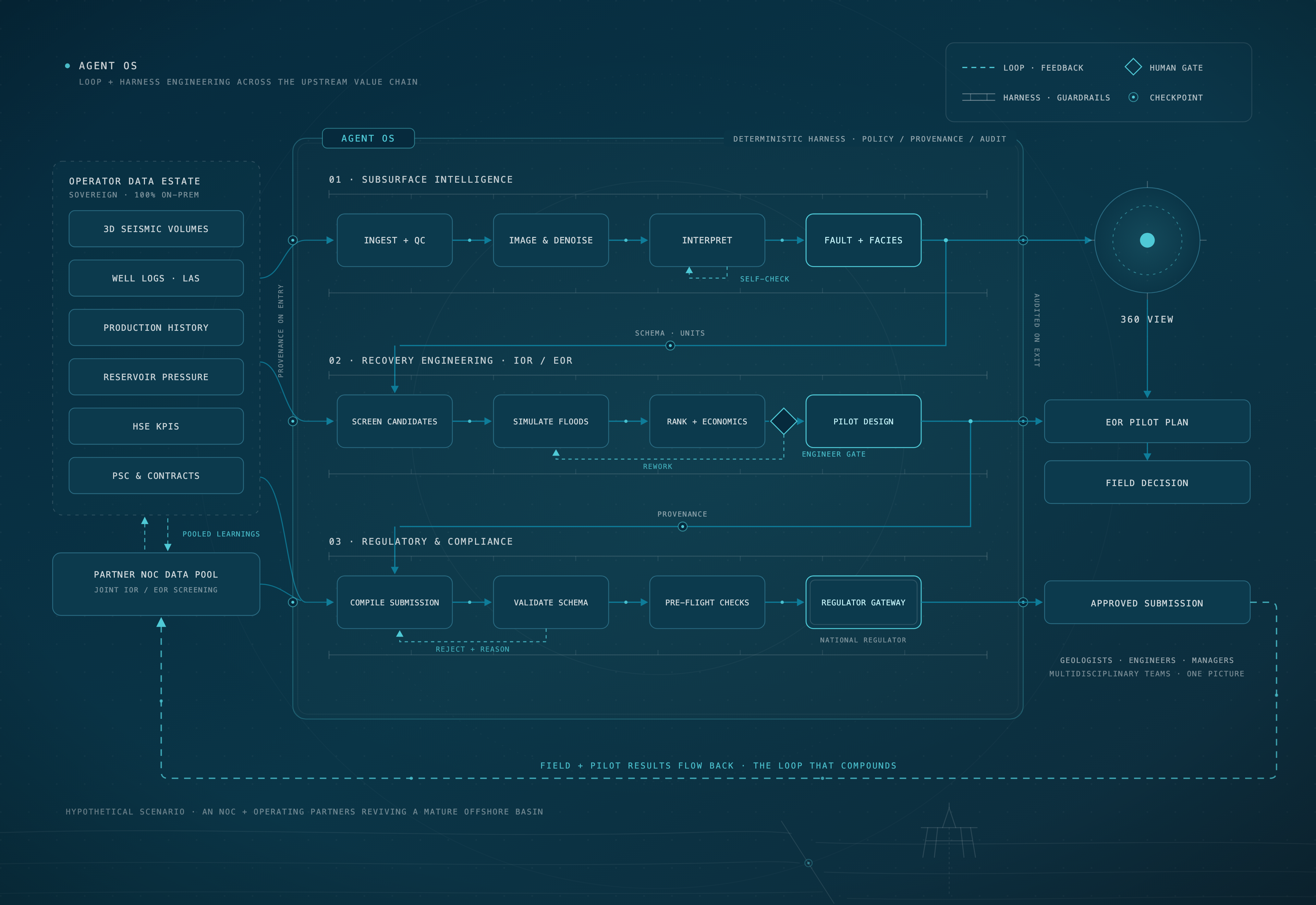
Consider a national oil company and its operating partners working a mature offshore basin, where waterflooding has reached its economic limit and the remaining barrels sit in complex reservoirs. Inside AI 360, the operator’s entire estate, 3D seismic volumes, LAS well logs, production histories, reservoir pressures, HSE records and contract obligations, feeds three harnessed pipelines that run as one system. The workflow diagram above shows exactly this scenario.
The subsurface pipeline ingests and interprets the data, running fault and facies detection with self-checking loops at every step. Its models feed a recovery pipeline that screens IOR and EOR candidates, simulates flood strategies and ranks them on economics, with a human gate where reservoir engineers approve the pilot design or send the work back. A third pipeline compiles the regulatory package, validates it against the national regulator’s schema and files it through the digital gateway, and a rejected submission loops back with the reason attached rather than dying in an inbox.
Every result, from a pilot’s injection response to a regulator’s approval, flows back into the estate and into the shared screening pool the partner NOCs maintain, so the models are recalibrated by the field itself. That is loop engineering working at four altitudes inside one deterministic harness, and it is why the platform’s answers keep improving the longer an operator runs it.
AI 360 runs fully sovereign and on-prem on the Hominis Foundation Stack. No data leaves the network, and the operator keeps its data, its patterns and its models. For an enterprise, that turns a lifetime of subsurface history into a compounding asset rather than something handed to a third party.
For years, applied AI in energy stopped at the proof of concept. With loop and harness engineering inside our Agent OS, the pipeline runs itself. A geologist defines the outcome and the system executes it deterministically, from end to end, whether the work sits upstream, midstream or downstream. That is what makes EarthScan AI 360 the first AI-native, hyper-automated platform for the industry, and it runs entirely inside the operator’s own estate. For an oil and gas major, their own data becomes the asset that compounds.
Automation of this depth changes the unit economics of subsurface work. When a pipeline that took weeks now runs unattended and repeatably, cost moves out of manual effort and into capability the operator keeps. Because everything runs on-prem, there is no data-egress risk and no third-party dependency to underwrite. Lower operating cost with full data sovereignty is what makes this defensible for the enterprise and for us.
Loop and harness engineering is how we make agentic automation deterministic instead of best-effort. The Agent OS composes each step into a pipeline with explicit guardrails, so fault detection or any other workflow produces the same, auditable result on every run. We built the Hominis Foundation Stack to carry this fully on-prem, so the operator’s data, patterns and models never leave the network.
As a geophysicist, what excites me is the transparency. Instead of stitching tools together by hand, a geologist sees the whole chain, from raw well and reservoir data through to a fault-detection result, in one 360-degree view. The engineers and the multidisciplinary teams all work from the same picture, which is exactly how good subsurface decisions get made inside a major.
EarthScan AI 360 with loop and harness automation is available now on the Hominis Foundation Stack for oil and gas operators. Existing deployments receive the automated pipelines as part of the platform, and teams can reach EarthScan through earthscan.io.
About EarthScan
EarthScan builds applied and agentic AI for the industries that power the world, from the subsurface to the grid. Its Agent OS and the Hominis Foundation Stack deliver deterministic, automated pipelines for subsurface imaging and interpretation, drilling and production advisory, and the energy transition through GreenScan, with a sovereign, on-prem-first deployment model.