“The companies that win this transition will be the ones that capture institutional knowledge from senior staff before retirement closes that window. AI is not the prize - captured tacit knowledge is.
”
The ongoing digital revolution - what's commonly framed as the "fourth industrial revolution" - is marked by the integration of advanced technologies such as AI, robotics, and autonomous systems. Within that wave, deep learning has the potential to transform traditional reservoir engineering practices and address some of the upstream industry's longest-standing challenges.
This piece is a condensed companion to the VeerNet AI whitepaper - the in-depth treatment of how a transformer-based vision model handles raster log digitisation at scale.
The deep-learning lever in upstream
Earliest raster archives in the typical operator's portfolio
Junior-petrophysicist interpretation time, before vs. after VeerNet
Operational levers automation pulls (efficiency / cost / quality / staff retention / customer outcomes)
Architecture under nearly every post-2017 AI breakthrough - the Transformer
Why digital transformation has been hard for oil & gas
The oil and gas industry, alongside mining, has been famously slow to embrace digital transformation. Three forces compound:
- Resource and expertise gaps in AI - small in-house data-science teams and an external talent market that overwhelmingly chases consumer-tech salaries.
- Slow technology-adoption cycles - capital projects measured in decades make "let's pilot this" a much harder sell than in software.
- The Great Crew ChangeA workforce phenomenon in oil & gas: senior geoscientists retiring faster than junior engineers gain enough field exposure to replace them. Domain knowledge walks out the door without a clean transfer path. AI's role: capture tacit knowledge while it's still in the building. - a generational gap in the workforce as senior geoscientists retire faster than junior engineers gain enough field exposure to replace them. Domain knowledge walks out the door without a clean transfer path.
These aren't excuses. They're the operating constraints any AI strategy in this industry has to ship inside.
Automation as a forcing function
To stay competitive, integrating AI and ML has emerged as a vital lever. Automation streamlines processes, reduces manual labour where it doesn't add value, and optimises resource use. Large-language models like ChatGPT - built on the transformer architecture - point toward an immediate use case: automating repetitive interpretation tasks and capturing tacit knowledge from senior staff before they retire.
Implementing automation in upstream operations delivers, in roughly this order:
- Improved operational efficiency - fewer manual handoffs in the interpretation pipeline.
- Cost and time savings - labour and rework costs drop; cycle times shrink.
- Improved quality and consistency - tasks performed identically every time, removing inter-interpreter variance.
- Higher employee satisfaction - engineers redirected from tedious clean-up onto higher-judgment work.
- Better customer outcomes - faster turnaround on internal and external deliverables.
Transformers - the architecture that changed the game
The TransformerThe neural-network architecture introduced in 'Attention Is All You Need' (Vaswani et al., 2017). Replaced recurrence and convolution with self-attention. The architectural foundation of nearly every AI breakthrough since 2017 - BERT, GPT, ChatGPT, Stable Diffusion, AlphaFold. (Vaswani et al., 2017)Vaswani et al. · 2017Attention Is All You NeedNeurIPS is the architecture under nearly every AI breakthrough since 2017: BERTBidirectional Encoder Representations from Transformers (Devlin et al., 2018) - the first transformer-based language model to demonstrate large transfer-learning gains across NLP benchmarks. The masked-language-model pretraining recipe that made transformers ubiquitous., GPT, ChatGPTOpenAI's transformer-based chatbot (released 2022) - the consumer-facing demonstration of large-language-model capabilities. Made 'self-attention' a household concept and accelerated transformer adoption across industries that had been transformer-skeptical., AlphaFold, Stable Diffusion. The core idea - self-attentionThe core mechanism of the Transformer architecture (Vaswani et al., 2017). Each output element is computed as a weighted sum of all input elements. Captures long-range dependencies that local convolutional kernels and stepwise recurrences cannot see in a single layer. - lets a model directly compare every token in its input to every other token, capturing long-range dependencies that recurrent and convolutional architectures struggled with.
The Vision Transformer (ViT)Dosovitskiy et al. (2021) - the application of the Transformer architecture to images. Splits an image into patches, treats each as a token, applies self-attention. Captures global image context that pure CNNs only approximate via deep stacks of receptive fields. (Dosovitskiy et al., 2021)Dosovitskiy et al. · 2021An Image is Worth 16x16 Words: Transformers for Image Recognition at ScaleICLR extended this from text to images. Instead of treating an image as a 2D grid for convolutions, ViT splits it into patchesThe Vision Transformer's preprocessing step: split an input image into fixed-size patches (e.g. 16×16 pixels), flatten each, and project to a fixed-dimensional embedding. Each patch becomes one token in the transformer's input sequence - the bridge from images to sequence-of-tokens., embeds each as a token, and applies the same self-attention mechanism. The benefit: ViT captures global image context - relationships between distant regions - in a way CNNs only approximate via deep stacks of receptive fields.
That global-context property is exactly what raster log interpretation needs. When you're identifying a fracture or a fault from a scanned log image, the diagnostic features aren't local - they span the full track and depend on context far above and below the candidate region.
VeerNet - transformers applied to raster well logs
VeerNet is the transformer-based deep-learning model EarthScan built specifically for raster log interpretation. It uses self-attention to identify individual curves from a single track in scanned legacy log images, providing fast, stable, scalable digitisation that replaces hours of manual mouse-clicking per log.
VeerNet was trained on a large in-house corpus of raster log images covering a wide range of vintages, scanning quality, and curve types. The training set captures the failure modes that off-the-shelf vision models miss: faded ink, overlapping curves, hand-annotated grid markings, and the typical scan artefacts of a 1970s log photographed in 2010 by an iPhone in a basement.
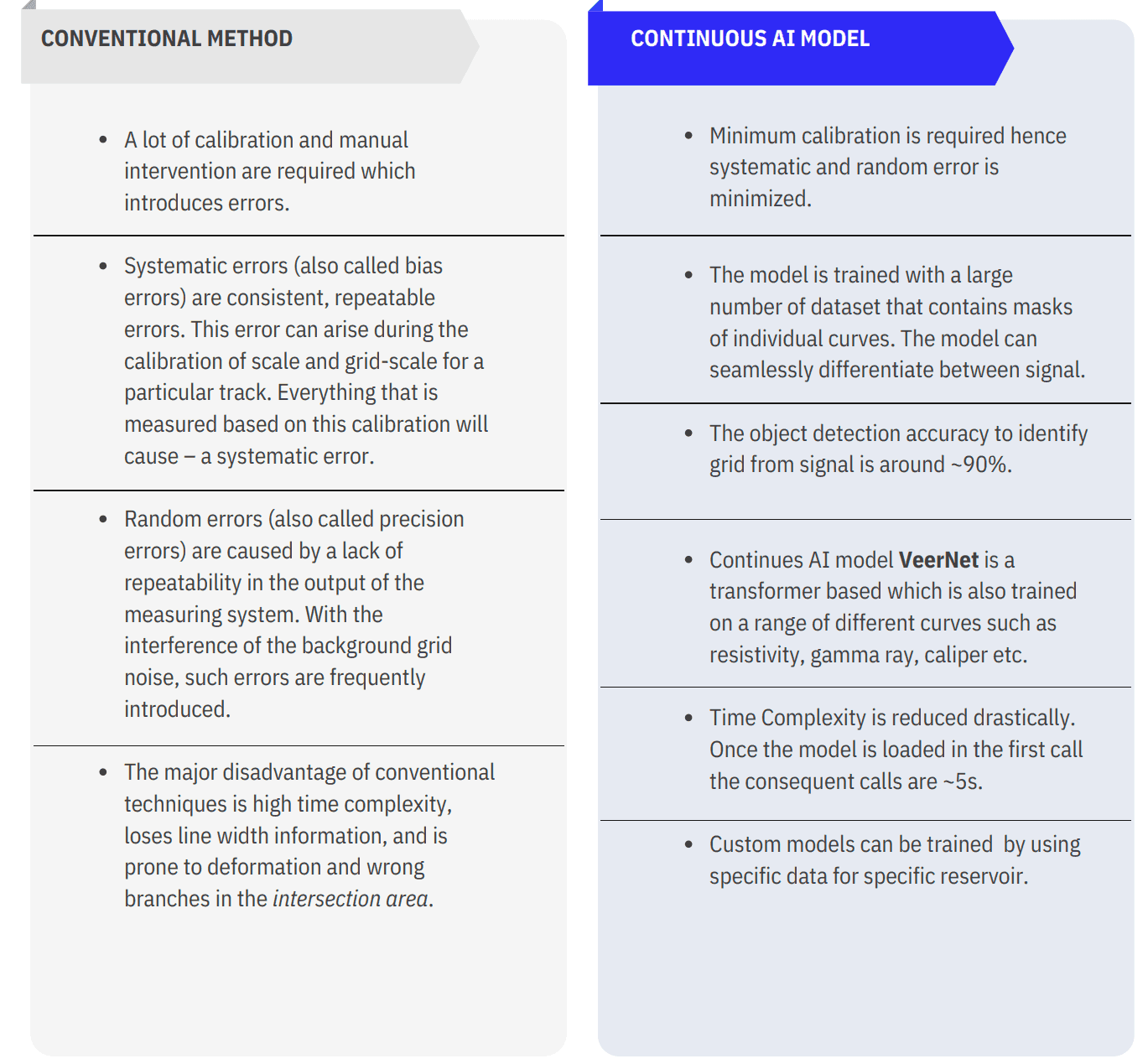
What VeerNet delivers in production:
- Reduced time complexity and faster interpretation - what took a junior petrophysicist a day takes minutes.
- Minimised systematic and random errors - eliminates click-jitter and inter-interpreter variance.
- Interactive dashboard UX - interpreters review and correct, rather than tracing from scratch.
- Scalable to different tracks and curves - same model, different curve types via fine-tuning.
- Custom model training per reservoir - operators can fine-tune VeerNet on their own historical archives for region-specific accuracy.
Managing the AI technical debt that comes with this
Adopting AI is not free. Models accumulate AI technical debtThe accumulating cost of running ML models in production - drift, training-data provenance gaps, brittle preprocessing, retraining-pipeline staleness. Analogous to software technical debt; ignored at your peril. - drift, retraining-pipeline staleness, training-data provenance gaps, brittle preprocessing - that can quietly degrade production performance.
Three recommendations:
- Track model performance against ground truth continuously, not just at training time.
- Budget for retraining cycles as a recurring operational cost, not a one-off project line item.
- Invest in upskilling existing geoscientists, not just hiring new data scientists. The combination of subsurface knowledge plus AI literacy is rarer than either alone, and far more valuable.
Closing thought
AI - particularly deep learning models based on transformers - has the potential to revolutionise geology interpretation in oil and gas. Automation powered by these models drives efficiency, cost savings, and better decisions. The companies that win this transition will be the ones that:
- Invest in AI skills among existing geoscience teams.
- Treat AI tooling as production infrastructure, not as a research curio.
- Use AI to capture institutional knowledge from senior staff before retirement closes that window.
For the full technical treatment - model architecture, training-data construction, benchmark comparisons against alternative approaches - see the VeerNet AI whitepaper.
Key takeaways
- Transformers (and Vision Transformers) are the architecture under nearly every post-2017 AI breakthrough - including the transformer-residual hybrid that powers VeerNet.
- The Great Crew Change is the AI urgency signal: senior geoscientists retiring faster than juniors gain field exposure. AI's role is to capture tacit knowledge while it's still in the building.
- The transition winners will upskill existing geoscience teams rather than just hire new data scientists. The combination of subsurface knowledge plus AI literacy is rarer than either alone, and far more valuable.
- AI technical debt is real - drift, retraining staleness, training-data provenance gaps. Treat AI tooling as production infrastructure, not a research curio.
Glossary
- AI technical debt
- The accumulating cost of running ML models in production - drift, training-data provenance gaps, brittle preprocessing, retraining-pipeline staleness. Analogous to software technical debt; ignored at your peril.
- BERT
- Bidirectional Encoder Representations from Transformers (Devlin et al., 2018) - the first transformer-based language model to demonstrate large transfer-learning gains across NLP benchmarks. The masked-language-model pretraining recipe that made transformers ubiquitous.
- ChatGPT
- OpenAI's transformer-based chatbot (released 2022) - the consumer-facing demonstration of large-language-model capabilities. Made 'self-attention' a household concept and accelerated transformer adoption across industries that had been transformer-skeptical.
- Great Crew Change
- A workforce phenomenon in oil & gas: senior geoscientists retiring faster than junior engineers gain enough field exposure to replace them. Domain knowledge walks out the door without a clean transfer path. AI's role: capture tacit knowledge while it's still in the building.
- Patch embedding
- The Vision Transformer's preprocessing step: split an input image into fixed-size patches (e.g. 16×16 pixels), flatten each, and project to a fixed-dimensional embedding. Each patch becomes one token in the transformer's input sequence - the bridge from images to sequence-of-tokens.
- Self-attention
- The core mechanism of the Transformer architecture (Vaswani et al., 2017). Each output element is computed as a weighted sum of all input elements. Captures long-range dependencies that local convolutional kernels and stepwise recurrences cannot see in a single layer.
- Transformer
- The neural-network architecture introduced in 'Attention Is All You Need' (Vaswani et al., 2017). Replaced recurrence and convolution with self-attention. The architectural foundation of nearly every AI breakthrough since 2017 - BERT, GPT, ChatGPT, Stable Diffusion, AlphaFold.
- Vision Transformer (ViT)
- Dosovitskiy et al. (2021) - the application of the Transformer architecture to images. Splits an image into patches, treats each as a token, applies self-attention. Captures global image context that pure CNNs only approximate via deep stacks of receptive fields.